
「你的育儿经」和孩子一起学习:小学英语语法知识汇总( 三 )
肯定句:There is/was a …
There are/were …
一般疑问句:Is/Was there …?
Yes, there is/was. No, there isn’t/was.
Are there…?
Yes, there are/were.
No, there aren’t/weren’t.
否定句:There isn’t/wasn’t …
There aren’t/weren’t…
Some 和 any:
一般情况下 , some用于肯定句中 , any用于否定句中 。 如:
There is some milk in the bottle.
There aren’t any pictures on the wall.
Is there anything new in today’snewspaper?
Be动词与后面所跟名词的就近原则:
There is a pen and two pencils in thebox.
There are some students and a teacherin the classroom.
There is _an old woman in thecar.
There is some __bread _ on the plate.
_Are there _ anyflowers on both sides of the street?
“Wh”的疑问句:
What:
1) What’s this/that? 2) What’s your name?
3) What are you doing? 4) What do you like/need?
5) What did you do? 6) What is his job?
7) What do you usually do at theweekends?
How:
1) How are you?
2) How old are you?
3) How do we go to the park?
4) How many apples can you see?
5) How much are they?
Who:
Who is that?
Who’s that boy in/with…?
Whose:
1)Whose is this bike?
2)Whose bike is this?
3)Whose bag is bigger, yours or mine?
Which:
1) Which one?
2) Which is longer, yours or mine?
3) Which season do you like best?
Where:
1) Where is the book?
2) Where are you from?
Why—Why?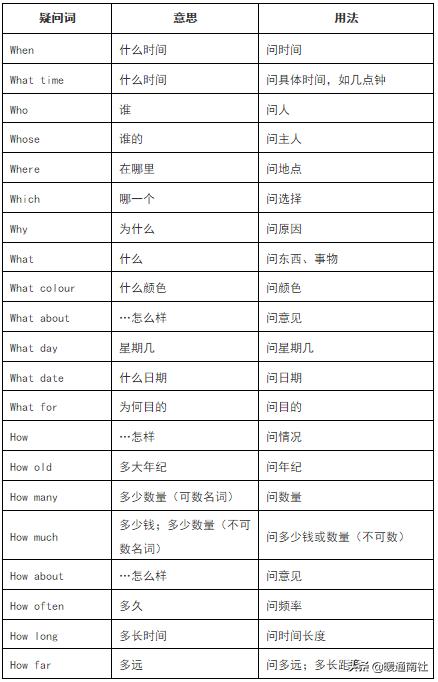
文章图片
例:
1.Tom visits the Science Museumevery year.
What does Tom visit every year?
2.The building near the factoryis the People’s hospital.
Which building is the People’shospital?
3.It’s cloudy today.
What’s the weather like today?
4.I usually take No. 4 bus towork.
Which bus do you usually take to work?
5.Uncle Wang feels better now.
How does Uncle Wang feel now?
6.I go to work at eight.
What time do you go to work?
7.They are cleaning their classroomnow.
What are they doing now?
祈使句:
表示请求或命令别人做某事或不要做某事 。
肯定祈使句一定是以动词原形开头(有时有please) , 否定的祈使句一定是don’t加动词原形开头(有时有please) 。
把祈使句改为否定句只需在动词前加don’t即可 。
来源于互联网学习资料整合 。 暖通南社整理编辑 。
推荐阅读







- 如果你的多肉出现这个长势,要注意这个细节,多肉才会越来越美!
- 【教育】教育担当 淮安:让孩子梦想花开|全面小康
- 『活动』让孩子们欢欢喜喜过新年 这个元旦好有爱!南京聋校举办多种形式庆祝活动
- “错抱孩子28年”案一审宣判:医院共赔偿76万余元
- 孩子|婆婆总夸“好带”,医生怒斥家长:太无知!1岁宝宝不哭不闹
- 孩子|吃黄鳝是导致儿童性早熟的元凶?
- 脸谱|盐都图书馆举办手绘京剧脸谱亲子活动 让家长陪孩子寻文化识国粹
- 肝脏|比生气还伤肝的5个行为,在“悄悄”损伤你的肝,尽量改掉
- 神话|武汉传奇父亲:一个平行班孩子创造的高考神话(感动上万家长)
- 孩子|张奶奶笔记:母乳是不是吃饱了?(权威文献摘录)